

PROF. RAFFAELLO COSSU
Introduction
The Circular Economy (CE) has emerged as a strategic framework for overcoming the limitations of the traditional linear economic model and addressing the structural challenges that undermine its long-term sustainability. These challenges include:
- the increasing consumption of non-renewable natural resources;
- the progressive depletion of resource stocks;
- geopolitical dependence on countries controlling critical raw materials, fossil fuels, and rare earth elements;
- the growing volume and complexity of waste streams;
- increasing concerns regarding the environmental and public health impacts associated with waste management systems;
- the rising complexity of the social, economic, and institutional relationships governing resource use and waste management.
The overarching objective of the Circular Economy is to decouple economic development from resource depletion and environmental degradation by transforming waste into valuable resources. This objective is pursued through a range of integrated strategies, including:
- extending product lifetimes;
- enhancing material recovery, reuse, and recycling;
- minimizing waste generation and residual outputs;
- creating value through repair, refurbishment, remanufacturing, and regeneration;
- promoting the eco-design of products that are durable, repairable, recyclable, and characterized by reduced levels of hazardous substances.
Achieving these objectives requires balancing economic growth, environmental protection, public health, and social well-being in accordance with the United Nations Sustainable Development Goals (SDGs).
Consequently, the Circular Economy should be viewed not merely as a waste management strategy but as a complex socio-technical system involving multiple stakeholders whose mutual interactions (schematically represented in Figure 1) strongly influence the effectiveness of the adopted strategies and the outcomes achieved. The different political, economic, and cultural influence exerted by the various actors can either facilitate or hinder the achievement of sustainability goals.
The Role of Key Stakeholders
Politicians
Political representatives are responsible for interpreting citizens’ needs, defining strategies aimed at the common good, developing public policies designed to improve quality of life, and allocating the resources required for their implementation.
Within the Circular Economy framework, they are called upon to establish objectives, priorities, and regulatory instruments capable of promoting the transition toward more sustainable production and consumption models. They must also foster awareness among citizens and businesses while maintaining continuous dialogue with the scientific community so that decisions are supported by the best available knowledge.
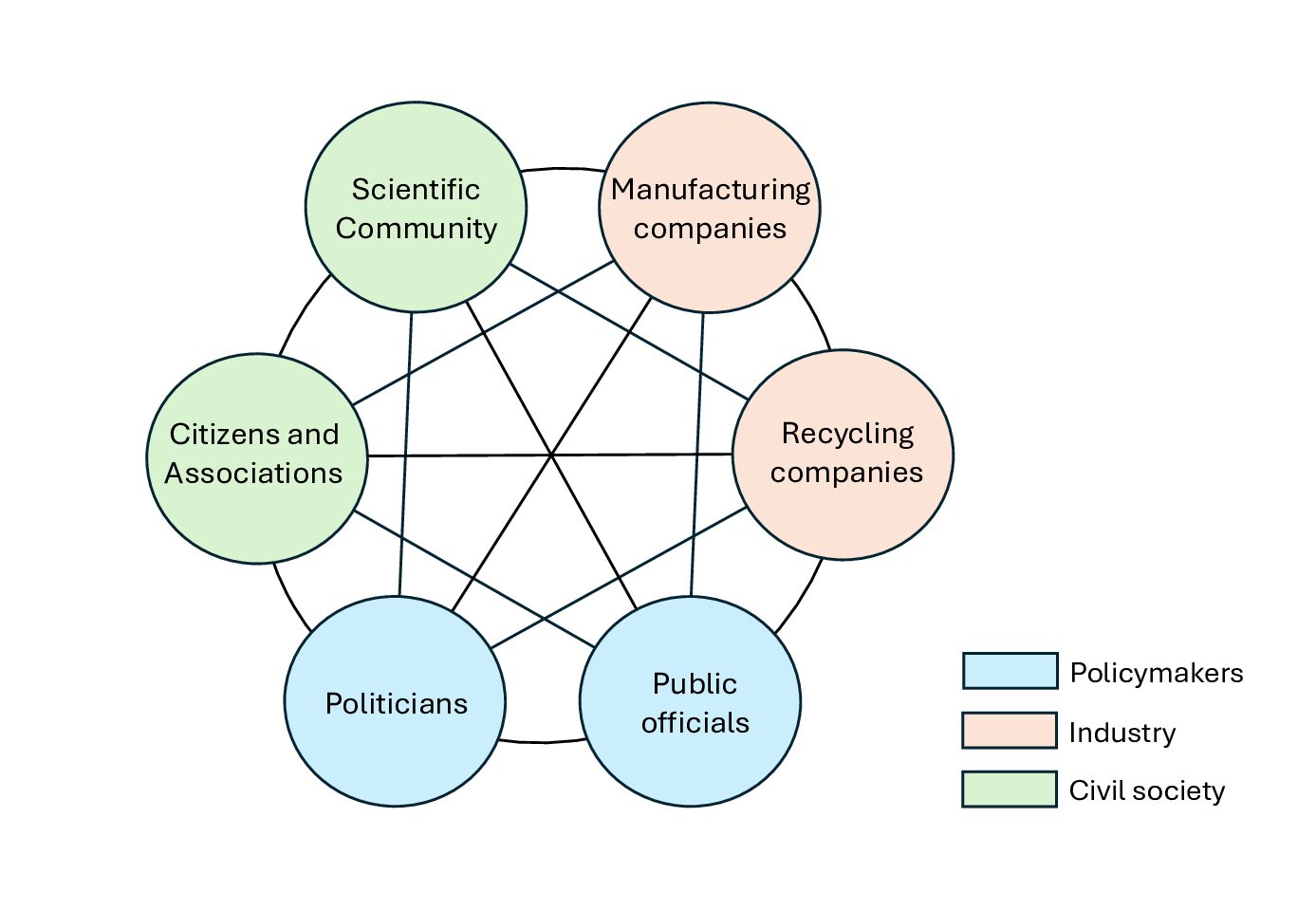
Figure 1. Schematic representation of the interrelationships among the main Circular Economy stakeholders.
Public Officials
Officials working within European, national, and local institutions play a central role in translating political decisions into practical actions. They develop technical and administrative measures, manage programs and funding schemes, monitor compliance with regulations, and coordinate services and projects.
Key aspects of the Circular Economy, such as End-of-Waste criteria, Extended Producer Responsibility (EPR), and the definition of environmental targets, largely depend on their work.
For this reason, public officials represent the primary interface for technical inputs coming from other stakeholders and should remain continuously updated through interaction with the scientific community, thereby avoiding administrative self-referentiality. They also constitute a privileged communication channel between institutions and citizens.
Citizens and Associations
Citizens contribute to the Circular Economy through responsible consumption patterns and sustainable behaviors, including waste prevention, conscious purchasing decisions, product life extension, participation in sharing economy initiatives, and proper waste separation practices.
Civil associations further support the transition by promoting awareness campaigns, educational activities, repair initiatives, reuse networks, and community-based circular practices. They also play an important watchdog role by monitoring the actions of both institutions and businesses.
A particularly important, yet still underdeveloped, dimension concerns the relationship between citizens and the scientific community. Strengthening this connection is essential to counter misinformation, improve scientific literacy, and foster a realistic understanding of both the opportunities and limitations of circular economy strategies.
Scientific Community
Scientific research constitutes one of the fundamental pillars of the Circular Economy.
Researchers contribute to the development of eco-design principles, innovative materials, advanced recycling technologies, and resource-efficiency solutions. Through collaboration with industrial stakeholders, scientific institutions support the optimization of production systems and the improvement of material recovery processes.
Beyond technological innovation, the scientific community plays a crucial role in providing objective evidence to policymakers and public administrations. By identifying emerging environmental and health concerns, evaluating risks, and proposing technically sound solutions, research helps ensure that circularity strategies remain scientifically robust and socially beneficial.
Scientific research also provides the methodologies required to assess circularity and sustainability performance. The development of indicators, life-cycle assessment tools, material flow analyses, and digital monitoring systems is essential for measuring progress and supporting informed decision-making.
Industry and Business Sector
The business sector represents the operational engine of the Circular Economy.
Companies produce goods and services that benefit society, create employment opportunities, and generate income for workers, suppliers, and investors, thereby making a substantial contribution to economic growth. Their primary objectives are profitability, long-term continuity, and market competitiveness.
Within the circular economy framework, two broad categories can be distinguished:
- manufacturing companies;
- waste recovery and recycling companies.
Manufacturing companies are increasingly required to rethink product life cycles by reducing dependence on virgin materials, improving product durability and reparability, incorporating recycled content, and minimizing waste generation throughout production processes. They are also expected to promote service-oriented business models and industrial symbiosis schemes in which waste streams from one process become resources for another.
Recovery and recycling companies, whether public or private, perform the strategic function of transforming waste into secondary resources. Through collection, sorting, treatment, recycling, and resource recovery activities, they contribute to closing material loops and reducing dependence on primary raw materials. At the same time, they must ensure the environmentally sound management of residual fractions that cannot be further recovered.
Governance Failures and Stakeholder Distortions
Many of the shortcomings observed in current circular economy systems originate from distortions in stakeholder roles, responsibilities, and interactions.
Several critical issues can be identified:
- political decisions influenced by vested interests, demagoguery, short-term electoral considerations or ideological biases, (as exemplified by persistent opposition to certain waste-treatment technologies);
- insufficient technical and scientific updating among parts of the public administration, whose participation in scientific forums has become increasingly limited;
- citizens’ vulnerability to misinformation and fake news, particularly through social media;
- difficulties within the scientific community in providing clear, consistent, and widely shared information, sometimes yielding to pressures associated with industrial lobbying;
- industrial strategies focused primarily on profit maximization through planned obsolescence, fast-fashion business models, and proliferation of disposable products;
- inadequate communication between manufacturers and recycling operators regarding changes in product composition and design;
- reluctance among some industrial operators of the environmental and health risks associated with products and or specific recycling pathways.
These distortions may undermine the credibility, efficiency, and sustainability of circular economy initiatives.
Persistent Systemic Challenges
In addition to stakeholder-specific weaknesses, several systemic challenges continue to hinder the effective implementation of circular economy strategies.
Among the most relevant are:
- insufficient prevention of disposable product generation;
- overly optimistic narratives that underestimate the technical and economic complexities of circular transitions;
- instability and volatility in secondary raw material markets;
- bureaucratic and regulatory barriers affecting End-of-Waste implementation;
- insufficient prevention of disposable product generation;
- limited adoption of Extended Producer Responsibility schemes aimed at combating planned obsolescence and ensuring proper end-of-life management, especially for products that are difficult to recycle (e.g., textiles containing elastane);
- the transfer of environmental burdens associated with recycling activities to developing countries;
- the absence of an integrated strategy capable of effectively coordinating all stakeholders throughout the value chain.
Addressing these challenges requires a more realistic understanding of how circular economy systems operate in practice.
Monitoring the mass balance for the sustainability of the circular economy
In essence, as just discussed, the main challenges in implementing the Circular Economy lie in the growing production of fast-moving consumer goods and in the lack of control over mass balances in material flows (regarding quantity, quality, the dispersion of contaminants and microplastics, and waste management). To make the ‘ ’ model truly sustainable, a strategy is needed based on monitoring material flows and closing the mass balance. This approach is governed by the life cycle of products, which adhere to the natural principle of mass balance (in a closed system, the total mass remains constant) and Lavoisier’s Law, according to which matter cannot be destroyed, but only transformed. A general representation of the life cycle is shown in Figure 2.
Material resources (renewable or non-renewable, e.g. metals, stones, timber) are extracted from a natural deposit (above or below ground) to feed into the production of goods.
The elements and compounds present in natural resources are generally found in a stable, immobile form (x). Following extraction and processing, they are mobilised to obtain the raw materials required for production,
At the end of their life cycle, goods become waste and enter the management phase, which includes storage, collection, sorting, transport and preparation for reuse. Materials not sent for recycling, or those that cannot be further recycled, are disposed of through treatment and, where necessary, final disposal in the ground in accordance with the ‘Back to Earth’ principle.
From the point of extraction onwards, the elements that had been mobilised continue to exist predominantly in a mobile form (S). During the various stages of the cycle, they may be released into the environment (at an emission rate (dS/dt)). These emissions may occur legally (emissions that comply with the limits set by national regulations) or illegally, and could give rise to unsustainable contamination (pollution), whether widespread or concentrated.
It is, however, a fact that concentrations of heavy metals and persistent organic pollutants in various environmental media (soil, water, air) are increasing worldwide (UNEP, 2025).
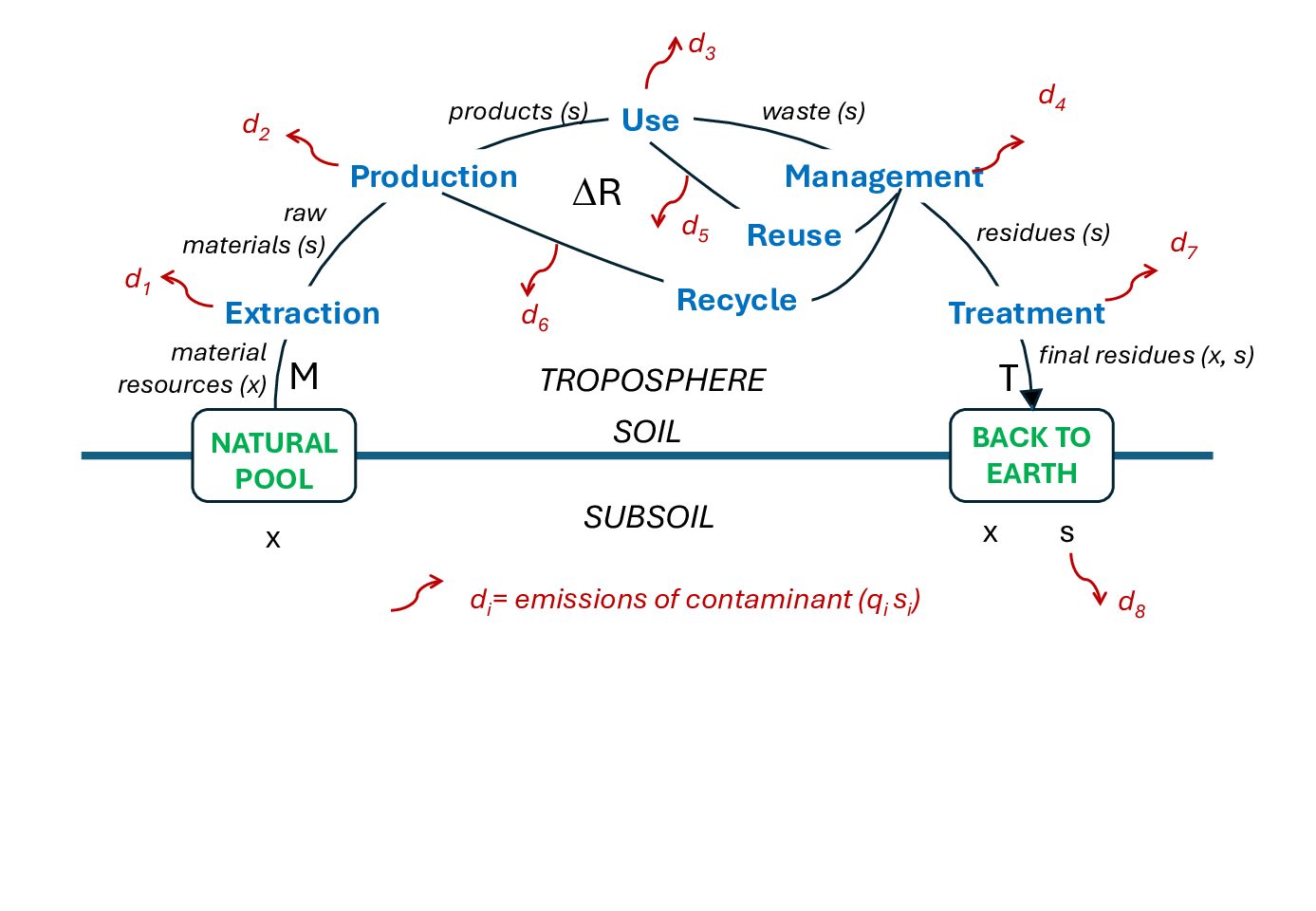
Figure 2. Graphical representation of the life cycle of products and waste. x = non-mobile form of the element in question, s = mobile form of the element in question, di= emissions of the mobile form of the element in question during the various stages of its life cycle (measured, for example, in g/d). M = quantity of material extracted; T = quantity of material deposited on the ground (sink) following inertisation treatment of the residues; DR = quantity of contaminant accumulated in the system through reuse, recovery or recycling; qi = emissions rate during the various stages of the life cycle; si = concentration of contaminant in the various emissions. (adapted from Cossu and Williams, 2024)
Considering the diagram shown in Figure 2, a classic mass balance equation can be derived for a given contaminant:
Incoming quantity of the contaminant extracted with the ore =
Sum of the quantities of contaminant leaving the system via emissions recorded at the various stages of the cycle + the quantity of contaminant accumulated in the system through reuse, recovery or recycling + the quantity of contaminant deposited in the soil after inertisation.
M*x = Sdi + DR*s + T*x (1)
By rearranging equation (1) and bringing the sum of all contaminant emissions to the first term, we obtain:
Sdi = M*x – DR*s – T*x
From this equation, it is analytically evident that, in order to minimise contaminant emissions, all terms on the right-hand side with a positive sign must be reduced, whilst all those with a negative sign must be increased. Therefore, to reduce the growing problem of global diffuse contamination, it is necessary to:
- reduce the consumption and extraction of the contaminant used in the production of goods (Mx)
- increase the recycling of the contaminant (DRs)
- increase the quantity of the contaminant that is returned to the Earth in an inertised form through deposition in the soil (Tx).
Strategic Priorities for the Future
The transition toward a truly sustainable Circular Economy requires the adoption of a comprehensive strategy based on several key principles.
Priority actions should include:
- comprehensive monitoring and control of material flows;
- ensuring the sustainable closure of mass balances;
- managing non-recyclable residues in a technically and environmentally sound manner, free from ideological biases;
- integration of prevention, reuse, recycling, energy recovery, and final disposal within a coherent resource management framework;
- strengthening the role of independent scientific research in policymaking processes;
- contrasting the distorting influence of lobbying activities on regulatory decisions;
- combating planned obsolescence and the production and widespread use of disposable products;
- minimizing the release of contaminants, hazardous substances, and microplastics throughout product life cycles;
- recognizing the strategic contribution of energy recovery from waste through scientifically validated technologies, including biofuels, biohydrogen production, chemical recycling of plastics, and thermal recovery of non-recoverable residual fractions.
The Circular Economy should therefore be conceived as an integrated system in which all components contribute to overall performance, much like interconnected elements within a complex mechanical system (Figure 3)
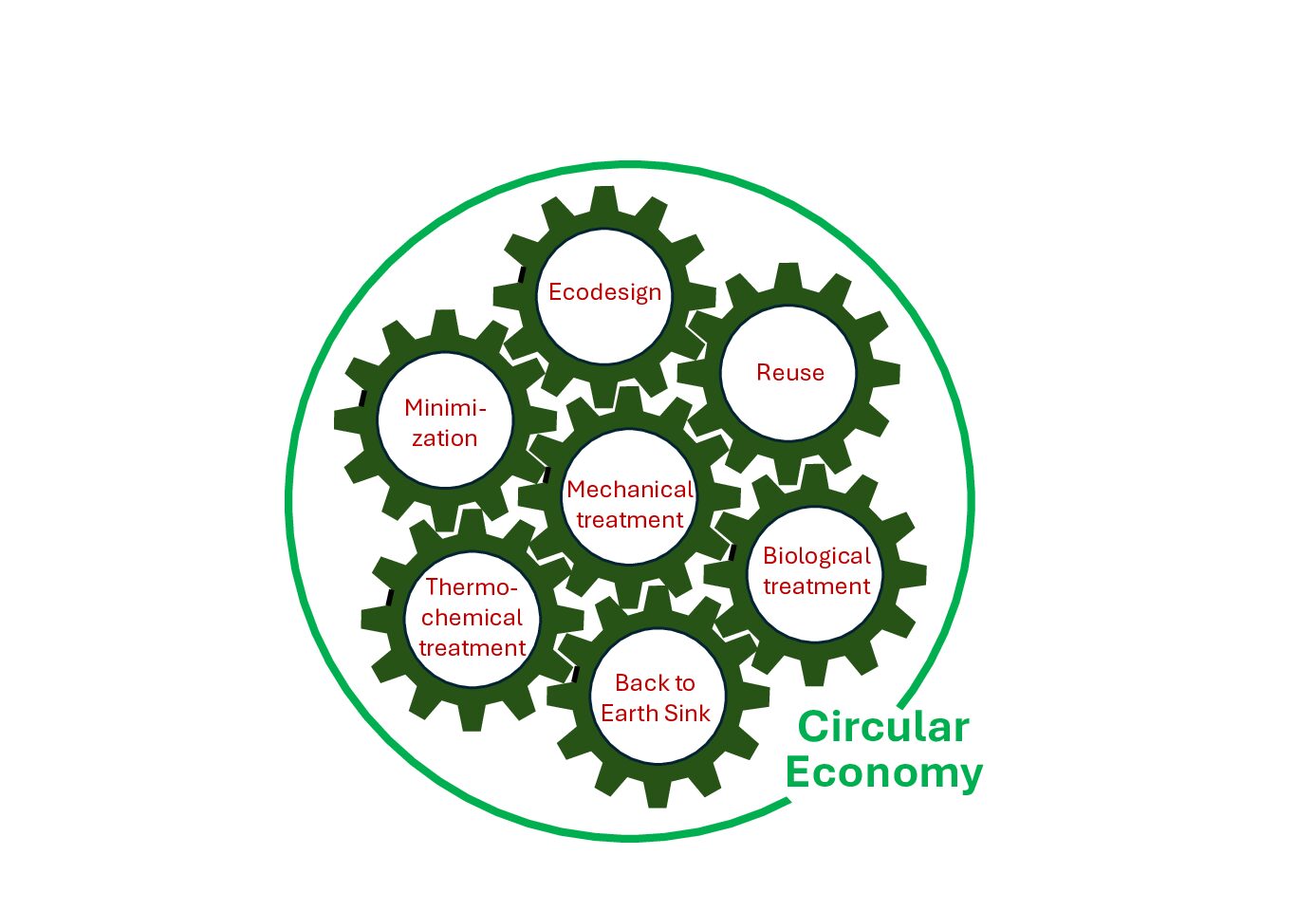
Figure 3- Graphical representation of the integrated management of products and waste from a sustainability perspective, supporting the objectives of the Circular Economy (adapted from Cossu & Ferrante, 2026).
Conclusions
The Circular Economy represents one of the most promising strategies for addressing the environmental, economic, and social challenges of the twenty-first century. However, its success cannot rely on simplified narratives or purely ideological visions.
Its limitations, challenges, and contradictions must be openly acknowledged and addressed through a scientific, pragmatic and systemic approach.
Through balanced collaboration among institutions, citizens, businesses, and the scientific community it will be possible to develop a truly effective Circular Economy model capable of combining environmental and public health protection, economic competitiveness, and collective well-being.
Ultimately, the success of the Circular Economy will depend on the ability of stakeholders to move beyond sectoral interests, embracing evidence-based decision-making. Only under these conditions can circularity become an effective pathway toward sustainable development rather than a merely aspirational concept.
References
Cossu (2026). Circular Economy across stakeholders: objectives, challanges and future perspectives. Detritus, (35), https://doi.org/10.31025/2611-4135/2026.19601
Cossu R., Ferrante M. (2026). Rifiuti e Salute. Criteri di Gestione, tecnologie e impatti. CISA Publisher. ISBN 978 88 62650489
Cossu R., Williams I. (2024). The need for sinks during the transition to a global Circular Economy. Detritus, (28), 1–4. https://doi.org/10.31025/2611-4135/2024.19427
UNEP-United Nations Environment Programme (2025). Global Environment Outlook 7: A future we choose – Why investing in Earth now can lead to a trillion-dollar benefit for all. Nairobi. https://wedocs.unep.org/ handle/20.500.11822/49014.


